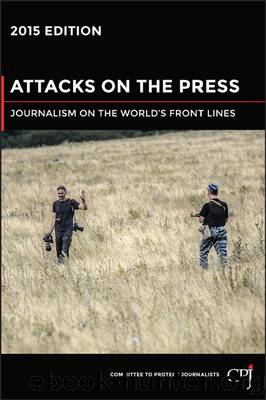
Attacks on the Press: Journalism on the World's Front Lines by Committee to Protect Journalists (CPJ)
Author:Committee to Protect Journalists (CPJ) [Committee to Protect Journalists (CPJ)]
Language: eng
Format: epub
Tags: Business & Economics, General
ISBN: 9781119107125
Google: YSjWBgAAQBAJ
Publisher: John Wiley & Sons
Published: 2015-03-25T20:25:51.627081+00:00
Liz Gerard, a former senior editor at Londonâs The Times, writes and edits the journalism website SubScribe.
13. Outdated Secrecy Laws Stifle the Press in South Africa
By Ferial Haffajee
A woman from the Right2Know campaign protests with her child against the Protection of State Information Bill, which would enable the prosecution of whistleblowers, public advocates, and journalists who reveal corruption, in Cape Town on April 25, 2013.
Source: AP/Schalk van Zuydam
Nelson Mandela regularly harangued the media once heâd been freed after 27 years of imprisonment by South Africaâs apartheid government. He would call individual journalists when he liked or disliked something they had written or when he wanted to advance a political lobby.
He once rattled the industry by complaining that black editors had not changed the template of journalism to match the requirements of a democratic era. Did he want the editors to be sweethearts? The question caused a stir.
In 1994 Mandela made a seminal speech on media freedom at a congress of the International Press Institute that set the bar high for what media freedom and free expression should look like in a democratic South Africa. He did so in one unequivocal proclamation: âA critical, independent, and investigative press is the lifeblood of any democracy.â
As an editor of the new era, I can attest that the South African media is, in fact, critical, independent, and investigative. I worked in decidedly un-free times and reported on the arrival of freedom. We in the media have taken our place, under constitutional protection, as a vital institution of society. We hold power to account. We are proud of our robust investigative bent and trenchant style. We are undoubtedly part of the lifeblood of our democracy.
Yet not everyone agrees, and as a result that lifeblood is under threat.
In his speech Mandela also observed, âThe press must be free from state interference.â Here, things get more complicated. The instinct of the powerful (both corporate and political) is often to stifle the dissemination of uncomfortable information. That, unfortunately, is taking a toll on press freedom in South Africa, where the media faces the real threat of an outdated secrecy law with the potential to harm a critical, independent, and investigative press.
The South African media still labor under old apartheid laws in which defamation is criminalized, unlike in more progressive countries that limit litigation over insults and alleged media harm to civil cases. South Africaâs antiquated National Key Points Act, legislation promulgated by âsecurocratsââmembers of the police and Security Service that dominated the South African government in the 1980sâto prevent access to key points such as police stations, the public broadcaster, politiciansâ homes, and nuclear facilities, can be used to prevent reportage.
In 2014 the media was consumed by a controversy over the spending of 300 million rand (about 30 million) on the presidentâs private estate, and the Key Points Act was invoked to prevent the publication of images of the property. Though the attempt to stifle publication of the images was unsuccessfulâpeople used social media to post images of
Download
This site does not store any files on its server. We only index and link to content provided by other sites. Please contact the content providers to delete copyright contents if any and email us, we'll remove relevant links or contents immediately.
Whiskies (Collins Gem) by dominic roskrow(45522)
Spell It Out by David Crystal(36231)
Cecilia; Or, Memoirs of an Heiress — Volume 1 by Fanny Burney(32716)
Cecilia; Or, Memoirs of an Heiress — Volume 2 by Fanny Burney(32083)
Cecilia; Or, Memoirs of an Heiress — Volume 3 by Fanny Burney(32063)
Beautiful Disaster by McGuire Jamie(25452)
Trainspotting by Irvine Welsh(21965)
Chic & Unique Celebration Cakes by Zoe Clark(20147)
The Secret History by Donna Tartt(19460)
How High Can a Kangaroo Hop? by Jackie French(18843)
Twilight of the Idols With the Antichrist and Ecce Homo by Friedrich Nietzsche(18775)
All the Missing Girls by Megan Miranda(16683)
Cat's cradle by Kurt Vonnegut(15549)
Ready Player One by Cline Ernest(15139)
For the Love of Europe by Rick Steves(14891)
Fifty Shades Freed by E L James(13346)
4 3 2 1: A Novel by Paul Auster(12609)
Crooked Kingdom: Book 2 (Six of Crows) by Bardugo Leigh(12447)
Grundlagen Kreatives Schreiben (German Edition) by Helfferich Pia(10521)
